 FormuSense is now more powerful than ever!
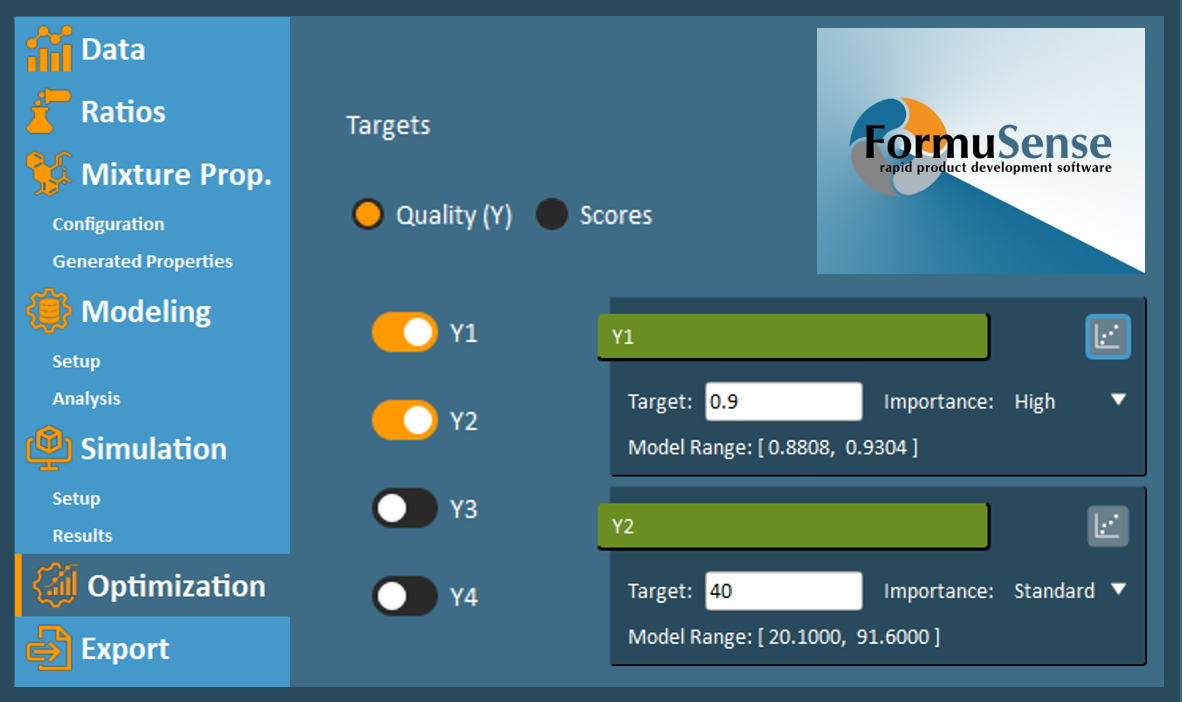
The “Optimization Release” of FormuSense includes multi-objective constrained optimization, allowing users to target quality. Optimization is a powerful feature that has the potential to dramatically accelerate materials discovery and innovation including new product development and product reformulation.
Optimization exploits predictive models in the backwards direction (specify Y to obtain X), whereas Simulation features (released in February 2023) apply models in the forwards direction (specify X to obtain Y).
Start Your Trial

Download a copy of FormuSense from the FormuSense homepage, and activate your 30-day trial today.
Attend a Workshop
Register to attend one of the upcoming 2-hour product development workshop with ProSensus. Workshops are a combination of lectures and FormuSense software tutorials.
Release Notes
What’s New
Optimization
-
- Determine the optimal formulation (ingredient selections and amounts) and process conditions to achieve specified quality targets under given constraints
- Configure up to 20 multi-objective optimization scenarios
- Set quality targets directly in raw units, or in the score space
- Review default bounds, and impose custom upper and lower bound constraints on quality, cost, process conditions, ingredients (including availability of an ingredient or ingredient class, and min/max allowable amount), and mixture properties
- Adjust tuning parameters such as model extrapolation limits, optimization tolerance sensitivity, optimization iterations, and optimization objective function weights
- For each optimization configuration scenario, compare tabular and graphical results (metrics, quality, formulation, process conditions, mixture properties, scores) for three distinct solution scenarios:
- Quality- and cost-balanced solution
- Highest-quality solution (minimizes deviation from quality targets)
- Lowest-cost solution (selects ingredients that minimize overall raw material costs)
- Compare each of the three optimization solution scenarios to the closest-matching existing/historical product