Ratio Derivations
After pre-processing the data, the ratio block is calculated. The ratio block can be viewed two ways – as one block which contains all ingredients, and as multiple blocks (by class) which contain ingredients in the class.
In matrix form, each row represents a formulation or product, and each column represents the ingredient, as shown:
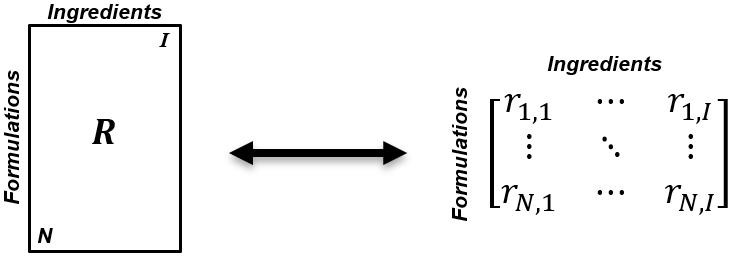
Each ratio in the ratio matrix is calculated by taking the mass, mass fraction, or weight percent of each ingredient and dividing by the sum of ingredients in that formulation, shown as follows:
Additional Remarks
In the case of weight percent or mass fraction, the denominator will be 1 as the sum of all ingredients should be 1.
The software will display the ratio matrix as percentages. In the mixture property calculations, the fractional equivalent using the calculation above is used.